From the lake, the region and the science
Our own stories from Newsletter Issue 1, then tilapia news from Zambia, the region and Africa, then new publications on the topics we work on. Updated as each newsletter issue appears.
On the road
The Board comes to Zambia
In October, our Board Chair Aino Olaisen and Vice Chair Odd Strøm joined Permit Shava on visits to the Centre’s research and training partners. First stop, the Copperbelt University, our newest MOU partner, and the National Aquaculture Research and Development Centre at Mwekera, where Zambia’s public fish seed is bred. They then visited the lecture rooms and laboratories of the University of Zambia School of Veterinary Medicine, home of the biobank and our vaccine work.
Why it matters: vaccines, surveillance and training all run through these three institutions. The Board saw the people and the benches, not just the plans.
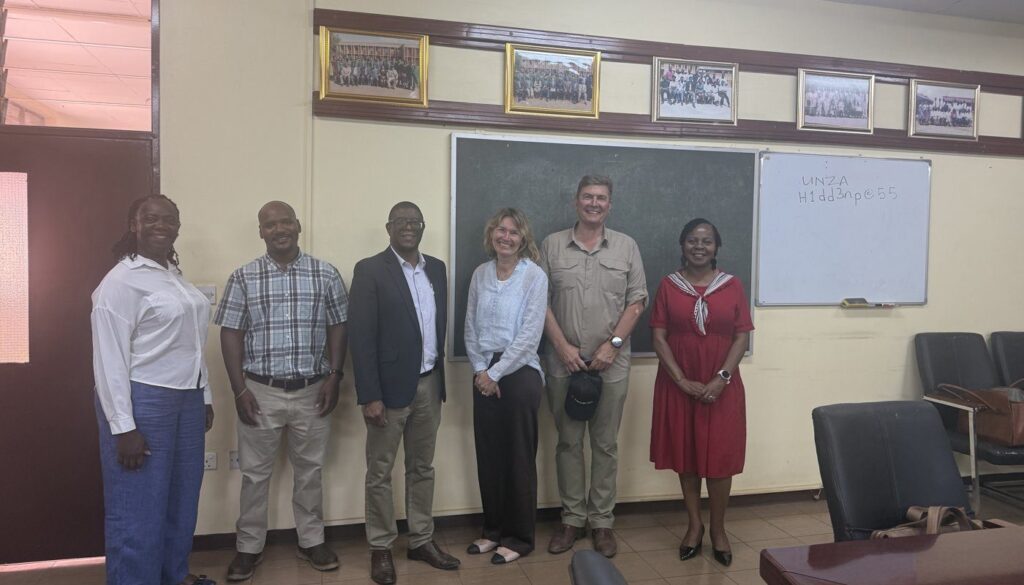
With the School of Veterinary Medicine team, University of Zambia, Lusaka
Siavonga smallholder clusters
Where the farmers are
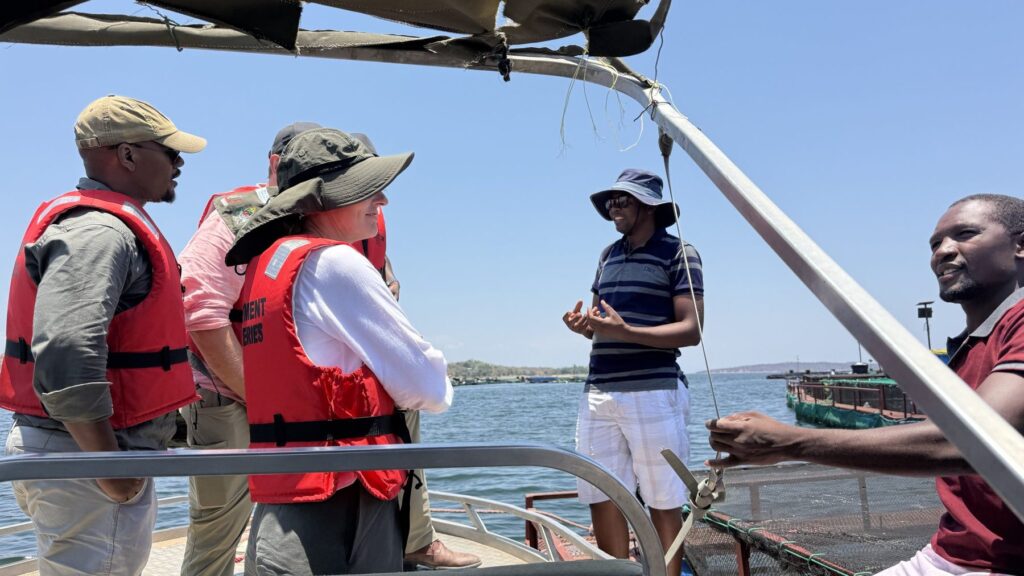
The week ended on the water. With the Department of Fisheries, the Board visited smallholder cage clusters on Lake Kariba near Siavonga: small groups of farmers running a handful of cages each, the people the Academy and the new seed are for.
What we saw. Good water, keen farmers, cages of mixed quality and fingerlings of unknown origin.
What we will do. Hands-on training from November, improved seed from 2027, and a disease surveillance net that reaches every cluster.
Why it matters: vaccines, surveillance and training all run through these three institutions. The Board saw the people and the benches, not just the plans.
With the School of Veterinary Medicine team, University of Zambia, Lusaka
People
The TCoE Academy is open for business
Good seed and healthy fish still fail in untrained hands. The Academy is our answer: five learner streams, one standard, taught on the water and online. The smallholder online pilot is live with Blue Planet Academy of Norway, with farmers learning on their phones between field sessions. Hands-on courses start in November. The five-day Master Trainer course, six modules, turns officers into trainers of farmers, led by Lazarus Tsokonombe.
Farmers and officers on the lake near Siavonga, where hands-on courses start in November
Fish health
One lake. One outbreak away. One biobank.
Almost all of Zambia’s cage fish grow in one lake. With the University of Zambia and national laboratories, we are building Zambia’s first tilapia pathogen biobank, to ISO 20387. Quality manual, governance pack, 18 SOPs and 23 forms were completed in October 2026. Bacteria first, viruses and parasites next. Vaccine pre-work started at UNZA in September 2026.
University of Zambia School of Veterinary Medicine
Looking ahead
Where the campus will be
Siavonga Town Council has allocated approximately 5.4 hectares in Siavonga Township for the TCoE Living Aquaculture Campus. Design is in progress: a building in stone, steel and wood that sits lightly in the terrain, housing the Academy, a demonstration hatchery, laboratories and trainee accommodation.
Watch this space.
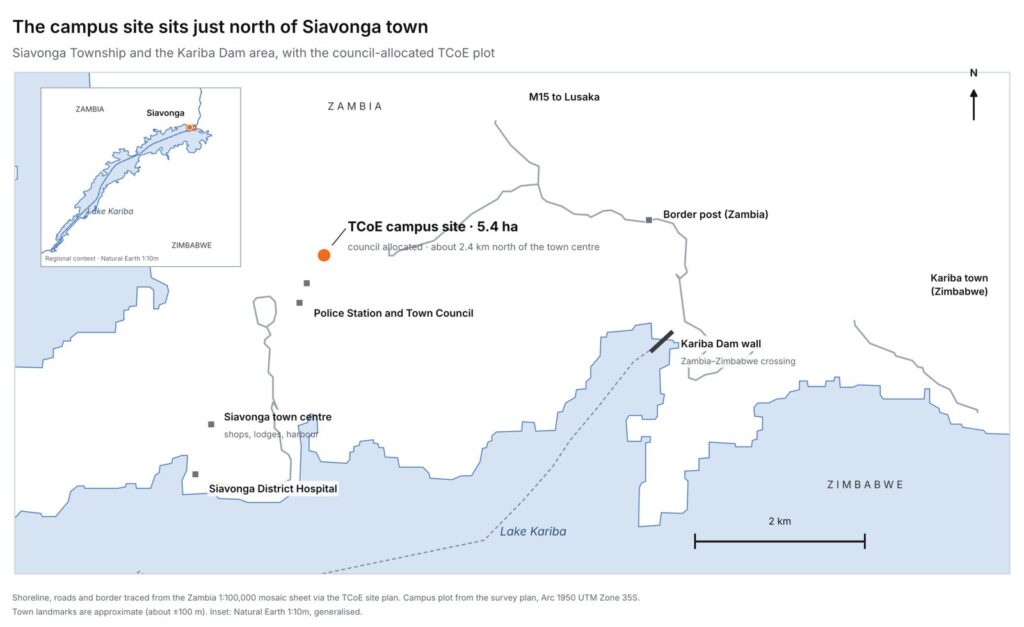
The council-allocated 5.4 ha site north of Siavonga town
November 2026
First hands-on smallholder courses
Next
Partner laboratories assessed for biobank hosting
Next
Ministry decision on the carrying capacity financing route
Next
Campus concept design, next round
Sector news
Tilapia news from Zambia, the region and Africa
Stories we are reading. Links open the publisher’s page. Compiled November 2026.
Zambia
2026-08-05
Government reports gains in livestock and fisheries sectors
Zambia Monitor, Zambia
Government says national fish production rose 53.7 percent to 238,636 tonnes in 2025, crediting aquaculture growth and better fisheries management.
2026-06-03
AquaCulture Pro launches FCR calculator for pond farmers
The Fish Site, Zambia
A free feed conversion tool used by Zambian pond farmers; Misamfu Aquaculture Fisheries recorded an FCR of 5.44 on indigenous tilapia fed standard pellets.
2026-05-22
Lake Kariba’s rising waters bring hope to communities in Zambia and Zimbabwe
Down To Earth, from The Conversation, Zambia
Kariba’s usable storage reached 42 percent for the first time since 2019, promising more power, fish spawning habitat and better catches.
Southern Africa
2026-07-20
Malawi weighs tax breaks for fish farmers as wild stocks dwindle
Nyasa Times, via AllAfrica, Southern Africa
Malawi’s minister floats tax and duty relief for cage farmers in Salima as Lake Malawi catches shrink; investors also want fingerlings and feed.
2026-07-16
Tanzania signs hosting agreement for major aquaculture conference
Fish Farming Expert, Southern Africa
World Aquaculture Tanzania 2026 brings more than 2,000 delegates to Dar es Salaam on 1 to 4 December.
2026-06
Zimbabwe nears 25 million fingerling mark as aquaculture sector expands
The Herald, Zimbabwe, Southern Africa
Zimbabwe produced 24.87 million fingerlings in the 2025/26 season to 5 June, stocking 352 ponds and 26 dams, says FARD director Milton Makumbe.
2026-03-26
Zimbabwe launches 5 million dollar plan to expand fish farming capacity
Ecofin Agency, Southern Africa
Zimbabwe’s first farmed tilapia marketing strategy, backed by FAO, the EU and BMZ, targets 14,000 tonnes by 2032 from 4,942 tonnes in 2024.
2026-02-22
Zimbabwe: floating hope, science, safety and resilience on the Zambezi
AllAfrica, Southern Africa
UNDP-backed floating cages at Musamba camp on Lake Kariba hold 73,000 fingerlings with 80 percent survival; 171 fishing households will take over.
Africa
2026-10-26
A father’s vision, a son’s ambition in Uganda
The Fish Site, Africa
A family-run Ugandan farm raises Nile tilapia and catfish across 12 ponds, with feed taking 60 to 70 percent of costs.
2026-06-17
Africa urgently needs more fish farms, UN tells ocean conference
Africanews, from AFP, Africa
FAO launches SOFIA 2026 in Mombasa: only 18 percent of Africa’s fish is farmed, and sub-Saharan output must grow 68 percent by 2050.
2026-05-06
Egypt gains first EU approval for farmed seafood exports
WeAreAquaculture, Africa
The EU lists Egypt, Africa’s largest aquaculture producer at 1.6 million tonnes, as an approved exporter of farmed finfish including tilapia.
2026-05-05
Chamber of Aquaculture and Virbac train farmers on biosecurity and disease control
MyJoyOnline, Ghana, Africa
Lake Volta farmers trained at Akuse on biosecurity and vaccination against Streptococcus and ISKNV, with vaccinated stock showing survival above 85 percent.
2026-04-27
Africa emerges as fastest-growing animal feed market in 2025
Ecofin Agency, Africa
The Alltech outlook shows African aquafeed output up 27.5 percent to 2.1 million tonnes in 2025, led by a 36 percent rise in Egypt.
2026-04-13
Tilapia producer Victory Group secures 15 million dollar follow-on investment from AgDevCo
WeAreAquaculture, Africa
The Kenya and Rwanda tilapia producer takes a 15 million dollar mezzanine loan, targets 30,000 tonnes in 2026 and early work in Tanzania.
2026-03-06
KMFRI warns of potential risk of mass fish deaths in Lake Victoria
Citizen Digital, Kenya, Africa
KMFRI tells Winam Gulf cage farmers to cut feeding and harvest early after oxygen fell below 2 mg per litre; 2024 and 2025 losses near 1 billion shillings.
New publications
Research on the topics we work on
Recent peer-reviewed papers and technical reports on tilapia health, genetics and seed, cage carrying capacity, and smallholder aquaculture. Compiled November 2026.
Fish health
2026
Zulu et al., Journal of Agricultural and Biomedical Sciences (UNZA) 10(2)
Four Lake Kariba bacterial isolates together caused 100 percent tilapia mortality within seven days, far worse than any single pathogen.
2026
Ndashe et al., Microbes and Immunity 3(2)
Zambian tilapia isolates carried few virulence genes, suggesting lower-virulence strains are circulating on farms.
2026
Vinh et al., Frontiers in Veterinary Science 13
A farm-made heat-killed Streptococcus vaccine gave lasting protection and raised survival, feed conversion and profit on a commercial tilapia farm.
2026
Disease and antimicrobial resistance surveillance for Nile tilapia pathogens in Lake Victoria, Kenya
Teplitz et al., Journal of Fish Diseases 49(1)
82 fish kills in 2020 to 2023 killed over 1.8 million tilapia, yet only 39 percent of farmers reported them to authorities.
2025
Ndashe et al., Journal of Agricultural and Biomedical Sciences (UNZA) 8(4)
Biosecurity knowledge was low across Siavonga cage farms, and small-scale producers had the weakest disease management practices.
2024
Duodu et al., Diseases of Aquatic Organisms 158
All 32 Lake Volta Streptococcus agalactiae isolates were serotype Ia, replacing the Ib type found in 2017, with implications for vaccine design.
2024
Alathari et al., PeerJ 12
Virus genomes recovered from cage water matched those in sick fish, so water sampling can track outbreaks without killing fish.
Genetics and seed
2025
Abaho et al., Animals 15(2)
Uganda has no systematic tilapia breeding programme, so there is little evidence that the current hatchery stock has been genetically improved.
2025
Geletu et al., Aquatic Living Resources 38
Three Ethiopian hatchery populations showed moderate diversity and weak differentiation, pointing to shared origins and a need for broodstock management.
Carrying capacity
2025
Cage-cultured Nile tilapia farming: a third generation of pollution in Lake Victoria, Tanzania
Komba et al., Aquaculture, Fish and Fisheries
Nutrient levels and turbidity in Mwanza Gulf rose sharply since 2015, with cage farming identified as a major new pollution source.
2025
Optimizing stocking density for enhanced fish yield in lacustrine cage aquaculture
Aura et al., Scientific African 28
Lake Victoria cages stocked at 70 to 150 fish per cubic metre grew and survived best, especially outside poor-water gulf sites.
2024
Rethinking freshwater cage aquaculture: a case in Ghana
Banini et al., Water 16(21)
Expanding Lake Volta cage farming threatens the ecosystem; the authors call for zoning, stronger regulation, and more land-based integrated systems.
2022
Aquaculture carrying capacity of Nile tilapia and Nile crocodile in Lake Kariba, Zambia and Zimbabwe
te Velde et al., Aquaculture Environment Interactions 14
A phosphorus budget puts Lake Kariba’s sustainable tilapia limit near 86,900 tonnes a year, with better feed conversion raising that ceiling.
Smallholders and nutrition
2025
Hasimuna et al., Frontiers in Sustainable Food Systems 9
Government-funded Siavonga cage farms raised incomes and jobs, but theft, predation, currency swings and bureaucracy limit competitiveness with private farms.
2025
Omar et al., BMC Veterinary Research 21
A Bacillus amyloliquefaciens probiotic at 0.4 g per kg of feed improved growth, immunity, and survival after Aeromonas challenge in tilapia fingerlings.